Product Description
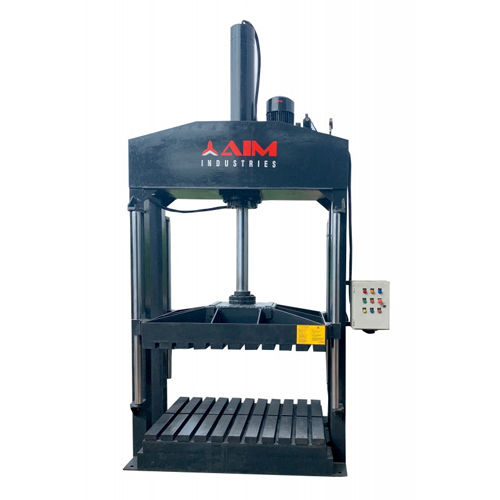
We are offering a wide series of Industrial HDPE Woven Sack Bags Baling Press. HDPE woven sack bags are compressed into dense bales using specialized equipment for simple storage and transportation. Businesses can select the bale size that best suits their needs thanks to the bailing press's variety of sizes and combinations. It is simpler to transport and recycle HDPE waste materials with Industrial HDPE Woven Sack Bags Baling Press, which helps to create a more sustainable waste management system. It is simple to use, with intuitive controls and detailed instructions.
Efficient Baling PerformanceAchieve high throughput with a production capacity of up to 8 bales per hour. Each bale can reach weights of up to 200 kg, facilitated by a 1.8 m3 chamber volume and a swift cycle time of 40-60 seconds, optimizing waste management in busy industrial settings.
Superior Build and Safety FeaturesBuilt from heavy-duty mild steel, this baling press boasts a sturdy frame designed to withstand continuous operation. Advanced safety features, including an emergency stop and interlock doors, ensure operator safety, while its low noise level makes it suitable for noise-sensitive environments.
Intuitive and Flexible OperationEasily manage all functions using the user-friendly digital control panel and Siemens PLC system. The press supports both semi-automatic and automatic modes, adapting seamlessly to different material handling needs while maintaining precision and ease of use.
FAQ's of Industrial HDPE Woven Sack Bags Baling Press:
Q: How does the automatic push-type bale ejector function benefit industrial operations?
A: The automatic push-type bale ejector expedites the removal of finished bales from the chamber, reducing manual handling and increasing workplace efficiency. This feature streamlines production, allowing operators to maintain a steady workflow and focus on loading and setup for the next bale.
Q: What materials can be processed using this HDPE woven sack bags baling press?
A: This baling press efficiently compacts HDPE woven sacks, plastic papers, and waste cotton. Thanks to its versatile design and robust pressing capacity (up to 100 tons of nominal force), it meets the requirements of various industries needing reliable waste management solutions.
Q: When should the oil tank, with a capacity of 350 liters, be checked or refilled?
A: Regularly monitor the hydraulic oil level before each operational shift, and refill or replace the oil as suggested in the maintenance schedule or when the oil level drops significantly. Using clean and specified hydraulic oil is crucial for smooth and safe machine performance.
Q: Where can this baling press be installed, and what are its spatial requirements?
A: The baling press is designed for indoor installation in industrial environments, such as factories handling plastic, textile, or packaging waste. It requires a minimum space of 2000 mm x 1400 mm x 3200 mm (LxWxH) for proper setup, operation, and maintenance access.
Q: What is the process of operating the baling press in semi-automatic and automatic modes?
A: In semi-automatic mode, the operator loads materials, initiates the cycle via the control panel, and monitors bale formation. In automatic mode, the system manages most functions, including bale ejection and pressure adjustment, with minimal operator intervention. The user-friendly digital display and Siemens PLC streamline the process in both modes.
Q: How does the baling press enhance workplace safety and reduce risks?
A: Multiple safety mechanisms, comprising an emergency stop button, safety interlock doors, and low operational noise (below 78 dB), collectively minimize accident risks and promote a safer environment for operators during both setup and continuous operation.
 Ahmedabad, Gujarat, India







 Send Inquiry
 Send Inquiry
 Send SMS
 Call Me Free


